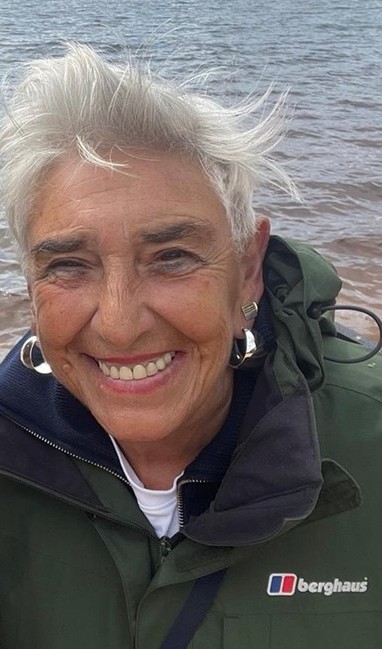
Anna Pia’s first book of non-fiction, Language of My Choosing published in 2017 by Luath Press was a Saltire Scottish National Book Awards Finalist for First Book. She was awarded the prestigious Premio Flaiano Linguistico in 2018, and The Crawford Gallery, Cork flash fiction prize in 2021. Anne read in Laziale Italian, French and Scots at the Edinburgh International Book Festival in 2025. She is an Associate of the Centre for Poetic Innovation at St Andrews University and a Member of the Guild of Food Writers. Anne also writes for Bite magazine and plays with the Gullane Ceilidh Band. Writing within a broadened linguistic context of English, French, Scots and Laziale Italian, her work focuses on migration-related issues, gender, otherness and sexual identities. Her latest collection honours both her profound attachment and identification with the language, culture and music of France and her rootedness in Scotland.
“Anne Pia has taken these pieces from French to Scots without losing their poise and from song to poetry without losing their music. Her Scots poems are both stylish and abundantly sensory, revealing her language in a new and unexpected guise. A rare and polymorphic talent.” Dr. Niall O’Gallagher, Poet in Residence, University of Edinburgh
“In this country, how do we begin to understand what are, to us, the mostly unfamiliar songs of Sète-born icon Georges Brassens? With Anne Pia, now we can read them in Scots, experiencing them ‘cantie at the full-flow’. And even those who have not heard the singer will soon appreciate why the mouthfeel of Scots is exactly the right medium to communicate the musician’s textured earthiness, his political verve and yes, even that ‘twinkle in his eye’, ‘Come barefoot nae need fer shoes’ and read these poems out loud. We can all do with being ‘bloomfu o starlicht’ today. Let both poets take us there.” Beth McDonough, Platform Poets
“A fascinating insight into the meeting of two folk cultures. Anne Pia’s lifelong passion for France, the French language and music, in particular for its ancienttroubadour tradition, informs this, her latest collection, The Daidlin Scents o Love. Her mastery of the Scots language brings the richness of the song of GeorgesBrassens, an artist thus far hidden from the world outside France, into a world where the Scots is heard and read. The deep warmth of Brassens’s distinctive and countercultural Occitan voice pours into Pia’s work through her responses to his lyrics. Sometimes rollicking, fast-moving, full of satire and dark humour, sometimes slow, full of love and longing, her poems sing in harmonywith the rhythms of the poet she calls an icon, a people’s poet, a French Bob Dylan.” Susan Haigh, University of Dundee
“Reading these echoes of Georges Brassens after he has been transmuted through Anne Pia’s imagination – and her Scots – it is as if his songs have been woven from the same threads as the Border Ballads and Burns: he becomes a ‘noble makar of licht’, a conjuror of nightingales, fireflies, fairy tales, nightmares and mischief. ‘Wha needs decorum’ one song asks, when you can dance with demons, and there are ‘wondrous secrets tae tell’? Naebody, I hope. A delightful collection, and a very apt reworking of Brassens.” Pàdraig MacAoidh, Scottish Makar, Professor of Literature, School of English, University of St Andrews